
Sindarin Genitive Constructs
[Originally posted by Ellanto 2025-09-16 on VLDS]
What I refer to as a "genitive construct" is the kind of genitive formation characteristic of Semitic (or perhaps Afro-Asiatic) languages on the one hand, and Insular-Celtic languages on the other hand; I am not aware of any languages outside these two families that have this type of construction, but please correct me if I'm wrong. What sets these genitive constructs apart from other types of genitive formations is that only the final noun in the sequence of nouns in a genitive relation can take on the definite article, and if the final noun is definite, then the entire phrase is treated as definite for all intents and purposes. In other words, we have the following pattern in Celtic and Semitic languages:
- X Y the-Z = "the X of the Y of the Z"
- X Y Z = "an X of a Y of a Z"
- Putting an article in any other place is entirely ungrammatical.
The evidence we have in Sindarin fits with this pattern, with the exception of 5 examples, which is why this pattern is relevant.
As far as I am aware, the majority of syntactical analyses of genitive constructs in Hebrew agree on the general principle of how these formations are derived in such a way that the definite article is blocked everywhere except on the last noun: movement of the head noun (the possessed item) from its base position upwards to where the definite article would be (the last element does not move, because it is not itself the head of a construct, and so it can have an article). I have seen some non-movement analyses, for both Semitic constructs and Welsh, but they are riddled with theoretical and empirical problems, often to the point of not providing any explanation for the lack of articles to begin with, and as such it seems reasonable to assume that the movement is necessary.
Now, what happens to adjectives? Attributing adjectives are adjoined (or merged, to use modern terms) at a level below the definite article, but above the level at which a genitive phrase is adjoined (because a genitive phrase is essentially a complement). This results in different behaviours depending on whether the adjective is adjoined to the left or to the right.
I'll add a picture with schematic illustrations of the structures, to make the explanation clearer. In the picture, X and Y are nouns and Adj is an adjective; where X and Y both appear, X is the head of a genitive construct (the possessed noun), and Y is the genitive noun (the possessor). In (1a) we have the adjective adjoined to the right of a non-construct noun (with a definite article), i.e. following it; in (1b) it is adjoined to the left, i.e. preceding it (as it does in English). In (2) we have a genitive construct: the line denotes the base position of X, which moves upwards to where its article would've been, and the Y is the genitive phrase, which is a complement to the base position of X.
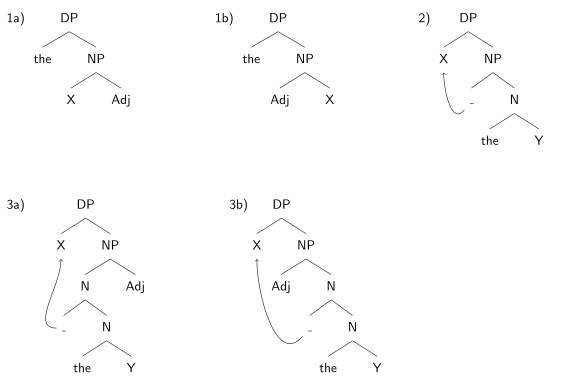
As I mentioned above, the adjective adjoins above the genitive phrase, as we can see in (3), where Adj is attributed to X. If adjectives adjoin to the right, as in (1a), then we end up with the situation in (3a), with the adjective ending up at the very end of the construct (no matter how many elements are in the constructed and to which element it is attributed). This is the situation in Hebrew.
If, however, adjectives adjoin to the left, as in (1b), then we end up with the situation in (3b), with the adjective immediately following after the noun it is attributed to inside the construct, even though when there is no construct the adjective would precede the noun. This is not quite the situation in Welsh, which is more complicated - I'll address that below.
First let's circle back to the original question. As I said yesterday, côf 'waeren (= 1a) is equivalent to côf Bel 'waeren (= 3a). However, Sindarin in principle also allows the adjective-first form gwaeren gôf, though it is not the standard/unmarked form. IMO the best way to account for this syntactically is by allowing Sindarin to optionally switch from its default (1a) to the (1b) format, which is more marked. Thus, gwaeren gôf (= 1b) is therefore equivalent to côf 'waeren Bel (= 3b). This alternation between (1a) and (1b) is where Sindarin differs from Hebrew, which can only ever do (1a), and ostensibly also from Welsh, which also doesn't show variable word order with adjectives as far as I know.
So what happens in Welsh? In Welsh the genitive constructs behave as in (3b), but non-construct nouns precede adjectives, unlike (1b). The noteworthy analyses I've seen account for this by assuming Welsh underlyingly has (1b), but it has an additional mandatory movement even in non-construct nouns. So in non-constructs the noun moves once, without blocking the article, and thus appears to the left of the adjective after all; and in constructs it moves again, this time blocking the article. This analysis depends on how quantifiers behave in Welsh, which, as far as I can tell, is different from how they behave in Hebrew, and, IMO, Sindarin's quantifiers behave more like in Hebrew than in Welsh. So IMO it is quite possible that whatever Welsh does is simply impossible for Sindarin, at least naturalistically, which is what led me to my conclusions above. But I've already written two walls of text, so I'm inclined to leave this part of the discussion for another day